- Why Train in Immersive Design? A Key to Reinvent Live Performance and EventsImmersion Sector: Key Figures and Trends to Watch in 2025.Immersive Design: An Experiential Revolution Serving EmotionFinding my voice, or how to adapt a show for the tourist marketBrand Activation, or how to harness the power of imaginationTowards the Summits: A “semin'air” that reboosts and inspiresMy Path... and Yours!Eat the Cake in Search of HappinessImmersive theatre for job seekersAn opportunity to seize, a branch to openOur visit to the F.R.I.E.N.D.S ExperienceHow to create the perfect virtual ChristmasAn immersion in the circus with BoxplanetPlaying Annie Oakley, a historical character, in an immersive show"A Midsummer Night's Dream" becomes realityFind Our TalentsThe Creation of a World
Immersive Design: An Experiential Revolution Serving Emotion
The world of live performance and event industry has undergone a radical transformation over recent years. At the heart of this revolution: immersive design, an approach that places emotion, interaction, and immersion at the center of all artistic or event creation. Far from traditional formats where the audience remains passive, experiential design invites participants to become actors of what they live. It no longer involves just seeing or listening, but feeling, immersing, living a complete and unforgettable immersive experience.

A New Way to Conceive Art and Event
Immersive design disrupts established codes. It proposes designing setups where the spectator leaves their observer role to actively enter a story, a universe, a fiction. The idea is to create sensory, narrative, and emotional experiences that fully engage participants. This type of approach is now adopted in many fields: visual arts, immersive theater, museography, scenography, event marketing, and participatory installations.
This practice does not rely solely on technologies like virtual or augmented reality. It also values storytelling, human interaction, immersive décors, and sound or light setups. It is even possible to offer a powerful immersive experience without technology, simply through fine narrative writing, well-thought scenography, and engaging acting.
Change your vision of the world of performing arts!
Sign up for the training to gain these skills
The Magic Circle: Total Immersion
At the heart of experiential design lies a fundamental concept: the Magic Circle. This term designates the symbolic space where the participant agrees to leave their daily life to enter a parallel, fictional or stylized world. In this context, they temporarily abandon their usual landmarks — social role, habits, rhythm — to be carried by the proposed universe.
This psychological shift is essential. It allows for a strong emotional connection and creates an opening to the unexpected, the unforeseen, the surprise. In an immersive experience, the audience is not just a spectator; they become co-creator of the moment, through their reactions, choices, interactions.
An Unavoidable Evolution in Live Performance
Live performance, in particular, greatly benefits from experiential design. In hybrid forms mixing theater, performance, dance, installation or digital art, artists experiment with new ways of storytelling, capturing attention, and provoking intense emotions. The audience is no longer seated in a dark room waiting for the play to unfold; they roam, interact, become a character or explore a space like a game.
This approach profoundly transforms the relationship between artists and their audience. It gives rise to free forms, often non-linear, where the experience is personalized, subjective, and unique to each individual.
A Response to Event Industry Challenges
In the event industry world, where competition to capture attention is fierce, immersive design becomes a strategic tool. Brands, festivals, cultural institutions, and companies now seek to propose innovative formats to stand out. A simple conference can turn into an immersive adventure. A product launch can transform into a complete sensory experience. A trade show can offer interactive itineraries that emotionally engage participants.
By creating a strong link between the offered content and the lived experience, we not only strengthen the memory impact but also audience engagement. This is particularly valuable in a world where attention is fragmented and emotions prevail over raw information.
Differentiate yourself from your competitors!
The Central Role of Emotions
Emotion is key. In an immersive experience, the feeling takes precedence over technical performance. Even with few means, it is possible to impress by placing humans and emotion at the center of the approach. Whether through subtle acting, well-thought lighting, enveloping sound atmosphere, or engaging scenario, each element contributes to building a memorable experience.
This orientation toward emotion echoes a broader transformation in the relationship to performance and event: the audience no longer wants to consume, it wants to live. They seek intense moments that touch, change, and leave them different when they leave.
Why Train in Immersive Design?
Faced with these transformations, it becomes essential for live performance and event industry professionals to acquire new skills. Understanding immersion mechanisms, knowing how to design interactive journeys, mastering immersive storytelling techniques, or directing an audience within a live setup: these are now essential skills.
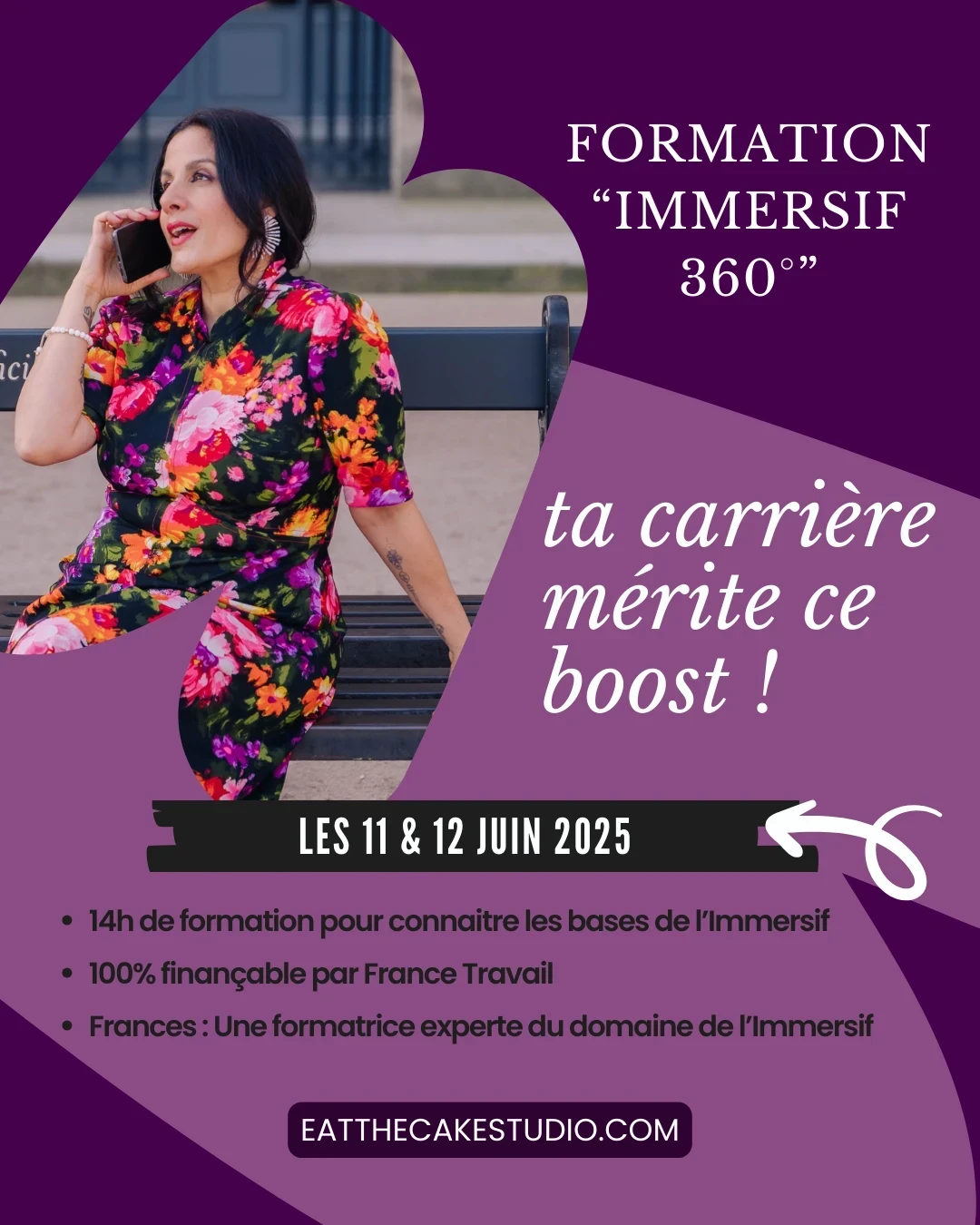
It is in this perspective that the Immersion 360° training offered by Eat The Cake Studio was created. In 14 hours, it offers an in-depth exploration of immersive design, mixing theory and practice, allowing artists, directors, producers, or event project managers to familiarize themselves with the tools and methods of this rapidly growing discipline.
Sign up for the training to gain these skills
Conclusion: A Creative Paradigm Shift
Immersive design is much more than a trend. It is a new way of thinking about art, performance, event industry, and human interaction. It proposes a paradigm shift where the artist becomes a world creator, and the spectator an active traveler.
Diving into this universe opens the door to an infinity of creative possibilities. And it also concretely means equipping oneself to meet the expectations of a public increasingly seeking meaning, emotion, and participation.