
A brief history of sideshows
It seems that sideshows (or freak shows as they were called at the time) started in the 16th century. Generally, these were traveling shows, going from town to town and sometimes part of a larger fair.

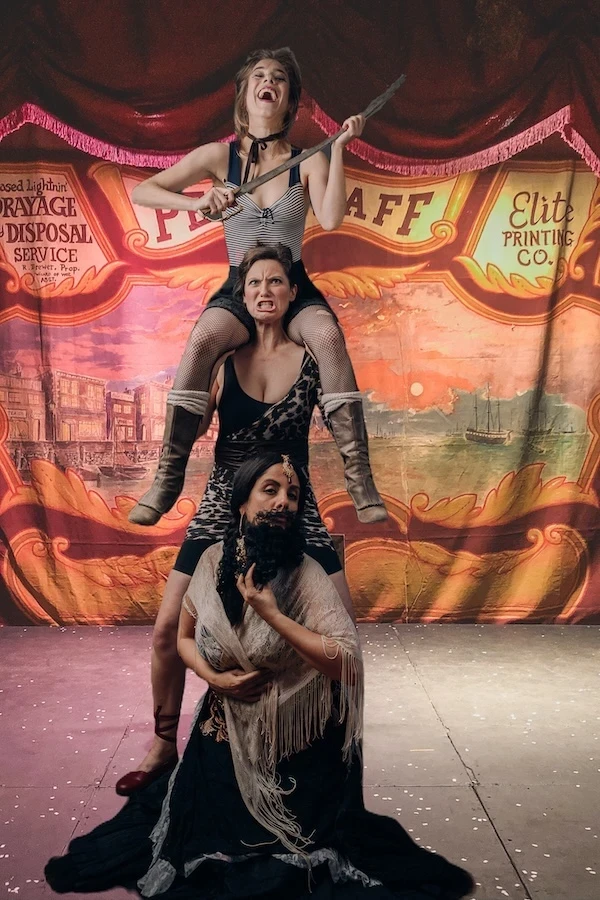
The most popular “freaks” were apparently people with extra limbs (or none at all) and dwarfs. There was also the trend of “pickled punks", which were fairly well-developed fetuses or stillborn babies preserved in jars of formaldehyde. Those who had deformities or anomalies, such as conjoined twins, were particularly sought after. They were often exhibited alongside living people with identical anomalies to add an extraordinary effect.
The 19th century was the resurgence and golden age for sideshows in Europe and then the United States. Industrialization meant people had money to spend and were eager for entertainment. In the United States, “Dime Museums” sprung up absolutely everywhere. People could see a variety of exotic animals and unusual humans as well as strange objects and artifacts for just a “dime” (ten cents).
PT Barnum opened a museum of the sort that became hugely successful, which allowed him to create his circus later. His success was largely due to his ability and willingness to create elaborate and fascinating stories for his performers. For example, he found a pair of dwarfed twins and presented them as the "wild men of Borneo", captured when their tribe attacked a merchant ship. No one at the time questioned the story despite the fact that these men appeared very Caucasian.
At that time, “monsters” were sometimes just people of foreign origin, exotic and with cultures very different from those of Americans and Europeans of the time.
But since the latter two knew very little about the rest of the world (a bit like Americans today), a person with an unusual skin color, eye shape, or cultural custom (such as neck elongation rings) was worth seeing. Interestingly, some of these cultural peculiarities remain major tourist attractions and tourists pay well more than ten cents to see them.
Sideshow exhibitions eventually became outdated and they closed for multiple reasons. Mainly because scientific advances explained and eliminated the birth of people with major physical anomalies. Then doctors are now able to “repair” these anomalies at birth, so we no longer have people with extra limbs. Conjoined twins, although still occasionally born, are generally separated at birth. Extra hair growth can be removed and treated. Children who appear to have no limbs or other oddly shaped body parts are often aborted.
Moreover, the general level of knowledge and empathy has greatly increased worldwide and most people would no longer find it acceptable to exhibit “monsters” for entertainment, like animals in a zoo. People born with physical anomalies are no longer considered cursed or representative of black magic, as they often were in past centuries when they were sometimes hunted and killed. At that time, sideshow exhibitions could be a safe haven for these people, giving them social status and income as well as protection. Some of them even became quite famous not only because of their physical peculiarities but also for their talents and skills which were even more impressive considering their disabilities.
One could certainly argue that medical advances leading to the near-elimination of “freaks” have no doubt eliminated a lot of suffering because it must have been difficult to live with major physical anomalies, but on the other hand, one could also argue that by eliminating these “anomalies”, we also eliminate diversity and the possibility of extraordinary and uncommon lives.